
Power Ballad – Movie Review
 Power Ballad – Movie Review
Starring: Paul Rudd as Rick, Nick Jonas as Danny, Havana Rose Liu as Marcia, Jack Reynor as Mac, Peter McDonald as Sandy McDonald as Sandy, Marcella Plunkett as Rachel, Rory Keenan as Binzer, Keith McErlean as Kyle, Paul Reid as Bernard, and Beth Fallon as Amanda.
SYNOPSIS:
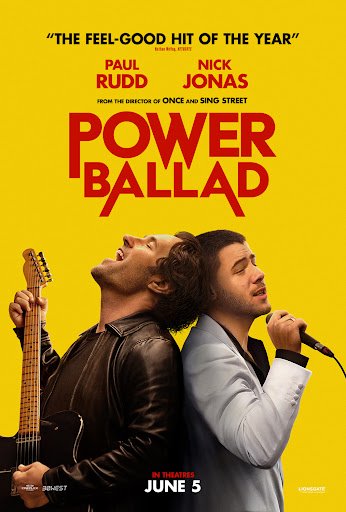
When Rick (Paul Rudd), a past-his-prime wedding singer, meets fading boy-band star Danny (Nick Jonas) during a gig, the two bond over music and a late-night jam session. But when Danny turns one of Rick’s songs into the hit that reignites his career, Rick sets out to reclaim the recognition he believes he deserves – even if it means risking everything he cares about. From writer-director John Carney (Sing Street, Once), POWER BALLAD is a feel-good story about music, self-respect, friendship, and the price of ambition.
Lionsgate presents, in association with 30WEST + Fís Éireann / Screen Ireland, a Likely Story / Distressed Films production, in association with Treasure Entertainment.
When I arrived at the AMC Theatre in Aventura for the Power Ballad screening, I immediately knew this wasn’t going to be a typical early showing. A live musician—Josh Gluck—was performing at the foot of the massive screen, filling the room with an acoustic set that set the tone long before the film even started. I walked in twenty minutes early, expecting the usual trickle of attendees, but the place was already packed. The energy was warm, lively, and surprisingly communal. It felt less like a screener and more like a pre‑show experience designed to ease you into the world of the film. And honestly, it worked.
As always, I go into these screenings blind. I accept them based on the synopsis and sometimes the cast, but I never watch trailers beforehand. I love experiencing a movie with zero preconceived images—no trailer moments, no expectations, no hints. If you’ve never done this as a moviegoer, try it at least once. It’s exhilarating to let a film reveal itself to you in real time.
Once the live music ended, the movie began, and Power Ballad wasted no time establishing its tone. The soundtrack is strong throughout, with a mix of catchy melodies and emotional undercurrents that fit the story well. That said, the film’s central song, “How to Write a Song Without You,” gets played a few more times than necessary. It’s a good track—written and performed by Nick Jonas himself, with a memorable hook—but by the final repetition, I found myself wishing the film trusted the audience to remember it without reinforcement.
The story unfolds largely as I expected, but that doesn’t mean it lacked charm. Paul Rudd’s performance as Rick is instantly likable. He plays a man who’s been knocked around by life but still carries a spark of sincerity and hope. Opposite him is Nick Jonas as Danny Wilson, a character who slowly reveals layers of dishonesty and self‑interest. Jonas develops Danny just enough to make you genuinely frustrated with him, which is exactly what the story requires. Together, the two create a dynamic that pulls you into the film’s central conflict—one rooted in trust, integrity, and the painful gray area between ambition and betrayal.
The film’s message is clear without being heavy‑handed: choose the high road, even when it’s the harder one. Stand up for yourself. Protect your passion. Don’t let others rewrite your truth. And just as importantly, listen to the people who care about you—especially when you don’t want to hear what they’re saying.
Supporting performances add real value. Peter McDonald as Sandy, Rick’s guitarist and best friend, brings a grounded, loyal presence that balances the emotional swings of the story. Beth Fallon, playing Rick’s daughter Amanda, adds heart and authenticity. Neither character feels forced or inserted for convenience; they fit naturally into the film’s rhythm and help flesh out Rick’s world.
The movie begins with a light comedic tone, but as Rick’s quest to prove Danny stole his song intensifies, the story shifts into more serious territory. A pivotal confrontation between the two artists—occurring well past the halfway mark—serves as the emotional turning point. It’s a strong scene, one that reframes the stakes and propels the film toward its final act. Even though I had a sense of where the story would ultimately land while Amanda was skimming around, the journey there remained engaging and satisfying. As felt by the audience reaction as well.
Power Ballad is, without question, a great date‑night movie. It’s a feel‑good film with enough emotional weight to spark conversation afterward—especially around themes of trust, creative ownership, and how one might react if placed in Rick’s situation.
At a brisk 1 hour and 38 minutes, the film moves quickly and never overstays its welcome. Not once did I feel my time was being wasted, which is more than I can say for many films in this genre. It’s not a great film, but it is a good one—earnest, entertaining, and easy to enjoy.
Go see Power Ballad. It’s worth your time.
— Jay Katz