
Onslaught Movie Review: Super Soldiers Miss the Mark
 Onslaught – Movie Review
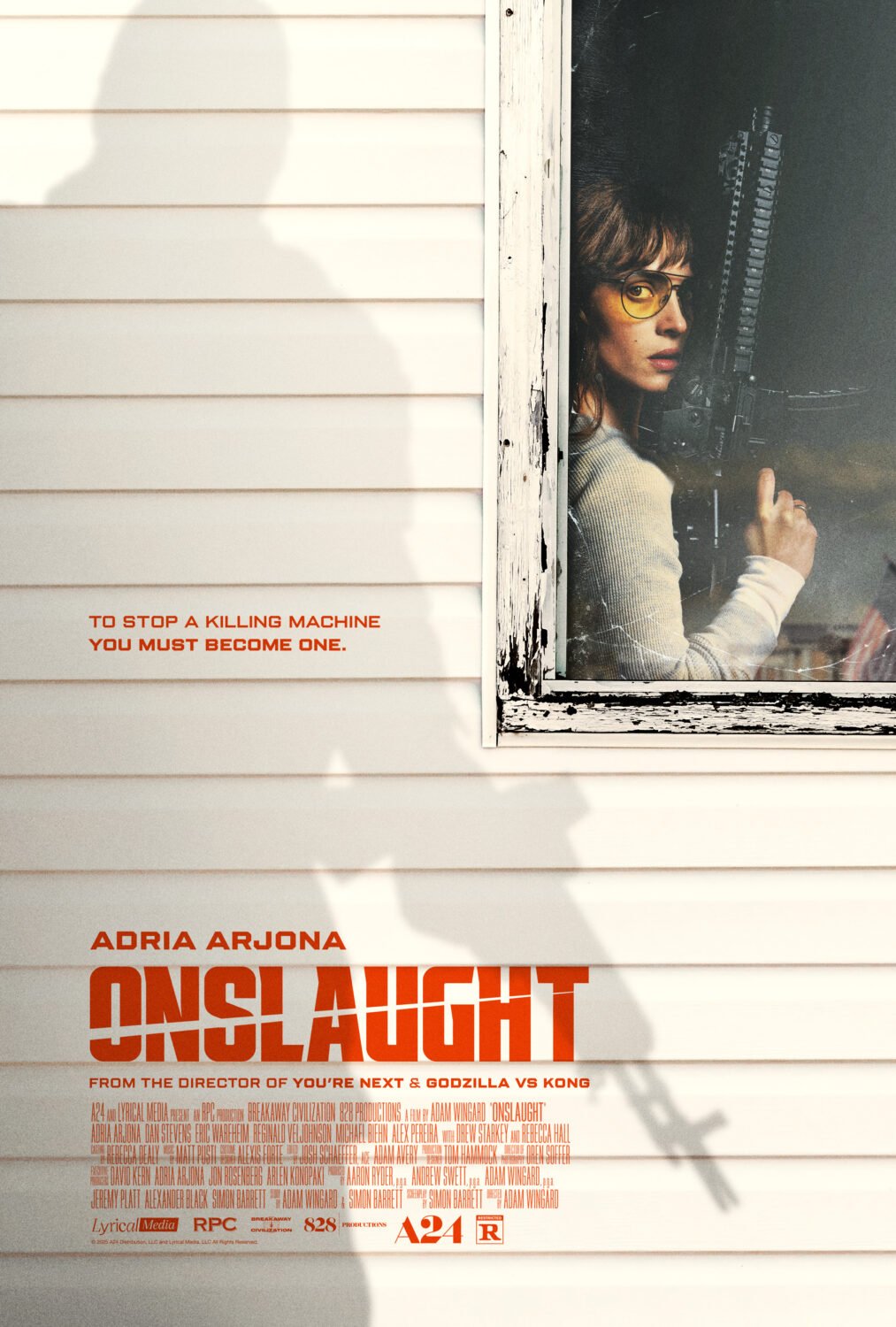 Onslaught – Movie Review
Onslaught Movie Review: Super Soldiers Miss the Mark
Release Date: September 4, 2026
Director: Adam Wingard
Screenwriter: Simon Barrett
Runtime: 92 minutes
Distributor: A24
Top Cast: Adria Arjona as Celeste, Drew Starkey as Cyrus, Rebecca Hall as Hanna, Dan Stevens as Hans, Eric Wareheim as Kovacks, Reginald VelJohnson as Josiah, and Michael Biehn as Baylor.
Synopsis: Former Army sniper Celeste is forced back into survival mode when a group of genetically engineered super soldiers escapes into the desert. With the killers closing in on the remote trailer park where she lives, Celeste must use her military training to protect her young daughter and anyone unfortunate enough to be caught in the soldiers’ path.
I go into every film screener with the intention of liking the movie first—or, at the very least, finding something redeemable within the story. I fully understand how much work goes into making a feature-length film. In this case, 92 minutes represents months, sometimes years, of work and dedication from everyone involved, from the director and actors all the way down to the person making the Uber Eats delivery to the set. I respect that. But when a film ends and I’m annoyed because I feel like I could have been doing something more valuable with my time, it becomes difficult not to get a little hasty with the criticism.
When the credits rolled on Onslaught, I sat there like a defiant child who didn’t get another blue slushie after spilling the first one all over the floor. The lights weren’t coming on. There was probably a post-credit scene. Maybe there wasn’t. At that point, I literally couldn’t have cared less. I got up and left, then remembered I had a 50-minute drive home. I was not a happy camper, to say the least. So, heads up—this may get a little ugly at times.
The paper-thin plot was enough to make this reviewer shift around in his seat more than a few times. It became increasingly uncomfortable watching everything unfold across this gorgeous IMAX screen, and eventually I started asking another question: Why exactly am I watching this in IMAX? Not everything requires the grandeur of an enormous screen. Dune, The Odyssey, Spider-Man, Avengers: Doomsday—those types of movies logically lend themselves to that massive presentation. Onslaught never gave me that feeling. Bigger does not automatically mean better, especially when the material itself never feels particularly big.
And then there was the sound. At least at my screening, it was ridiculously loud. Yes, I understand that IMAX is supposed to be big in every conceivable way, including the sound, but this became obnoxious. Scene after scene seemed buried beneath unnecessarily aggressive music. At times, I felt trapped inside one continuous 1980s MTV music video. Cue the slow motion. Cue the dramatic stare. Cue the shadowy figures standing ominously in the distance. Cue the glowing eyes. We get it. Their eyes glow. We got it the first several times. Instead of building menace, the constant repetition actually worked against these supposedly terrifying super soldiers. The movie kept telling me these guys were unstoppable killing machines while repeatedly showing me reasons to question that description. That became one of my biggest problems with Onslaught.
There were numerous scenes involving these “super soldiers” that simply made zero sense to me. One sequence in particular has the killers essentially stalling while Celeste and the others are holed up around the trailer park, running from one trailer to another. These genetically engineered killing machines suddenly need to strategize? Seriously? They’re dealing with an injured woman operating with one eye and limited resources, an aging Vietnam veteran, and a terrified young girl. Yet these super soldiers somehow have to regroup and plot their next move like they’re storming Normandy. Come on. I willingly pay money to watch a guy dressed in spandex shoot webs from his wrists and swing between skyscrapers in New York City, and somehow that feels more believable than portions of what happens here. That’s a problem.
I can’t place all the blame on the actors, because much of what doesn’t work begins with the material they were given. That said, there were performances and character choices that certainly didn’t help matters. Lead actress Adria Arjona, as Celeste, never completely sold me on the menacing, battle-hardened persona the film desperately wanted her to have. There were moments when the toughness felt forced rather than natural, which made it harder for me to completely buy into her as this intimidating former sniper capable of standing toe-to-toe with genetically engineered killing machines.
Then there’s Drew Starkey as government agent Cyrus. This character irritated me almost every time he appeared on screen. I couldn’t tell whether he was supposed to be a good guy, a bad guy, comic relief, completely unhinged, or some combination of all four. Maybe that uncertainty was intentional, but the quirky mannerisms and exaggerated delivery became more frustrating than interesting. Instead of wondering what Cyrus was going to do next, I found myself waiting for his scenes to end. For me, the character crossed the line from eccentric into over-the-top ridiculousness.
Rebecca Hall and Dan Stevens, as Hanna and Hans, suffer from a similar problem. Both performances lean so heavily into the dramatic side of their characters that it sometimes feels as though they’re trying to create far more depth than the screenplay actually gives them. There simply isn’t enough underneath these characters to support that level of intensity. When the foundation is this thin, pushing harder doesn’t necessarily make the character more compelling—it can make the weakness of the writing even more noticeable.
And that really becomes the bigger problem with evaluating the cast. With a script and premise this shaky, it’s difficult to place the disappointment entirely on the actors. They’re trying to bring energy, personality and menace to characters who often aren’t given enough substance to work with. Unfortunately, the remaining cast doesn’t fare much better. Whether it was the performances, the direction, the dialogue or some combination of all three, very little clicked for me. The entire thing increasingly felt like a collection of people trying very hard to elevate material that simply wasn’t giving them enough to work with.
Then we get to the gas station sequence. Ironically, this may be one of the more realistic moments in the movie in terms of how suddenly violence can erupt—and I absolutely hated it. The scene was disgusting, excessive, disturbing and, in my opinion, completely unnecessary. Given the climate we live in today, I struggled to understand what purpose this sequence served beyond demonstrating that the super soldiers are capable of indiscriminate violence. We already knew that. The movie had already established what they were supposed to be. So what exactly did this add?
If the purpose was to demonstrate their capabilities and establish these characters as unstoppable killing machines, the same point could have been made inside the military facility. Put these enhanced soldiers against a larger group of trained combatants. Show us why they’re terrifying. Show us why conventional soldiers cannot stop them. That would have accomplished essentially the same storytelling goal without what felt to me like mindless violence for the sake of mindless violence. And worse, after establishing these characters as brutally efficient killing machines, the film later has them struggling against a dramatically smaller and less-equipped group of people. That contradiction weakened them tremendously. Instead of fearing these super soldiers, I started questioning them.
Onslaught can easily be described as a modern-day cousin of Universal Soldier from 1992. Genetically or scientifically enhanced military killing machines, secret programs, government involvement, nearly unstoppable soldiers—it’s difficult not to make the comparison. The difference? Universal Soldier was more entertaining. The Jean-Claude Van Damme and Dolph Lundgren film knew exactly what type of movie it wanted to be. It gave audiences memorable characters, memorable confrontations and enough ridiculous action to completely embrace its premise.
Onslaught feels like Jason Voorhees showed up with a couple of his friends, announced that they were unstoppable military badasses, and then spent much of the movie trying to convince us of it. They came away looking surprisingly weak, figuratively and literally. There are obvious slasher influences running through the film as well, with the enhanced soldiers deliberately presented as hulking, nearly silent boogeymen. I understand what the movie was trying to do. I simply don’t think it worked.
If you’ve never watched the 1992 Van Damme/Dolph Lundgren film Universal Soldier, do yourself a favor and watch it. Then watch Onslaught. The similarities are certainly there. The difference is that more than three decades later, Universal Soldier somehow still comes away feeling like the stronger, more entertaining version of this particular brand of super-soldier insanity. And that might be the most disappointing thing about Onslaught. There was a fun movie buried somewhere inside this thing. I just wish they had let it out.
-Jay Katz