
I Play Rocky – Movie Review
 I Play Rocky – Movie Review
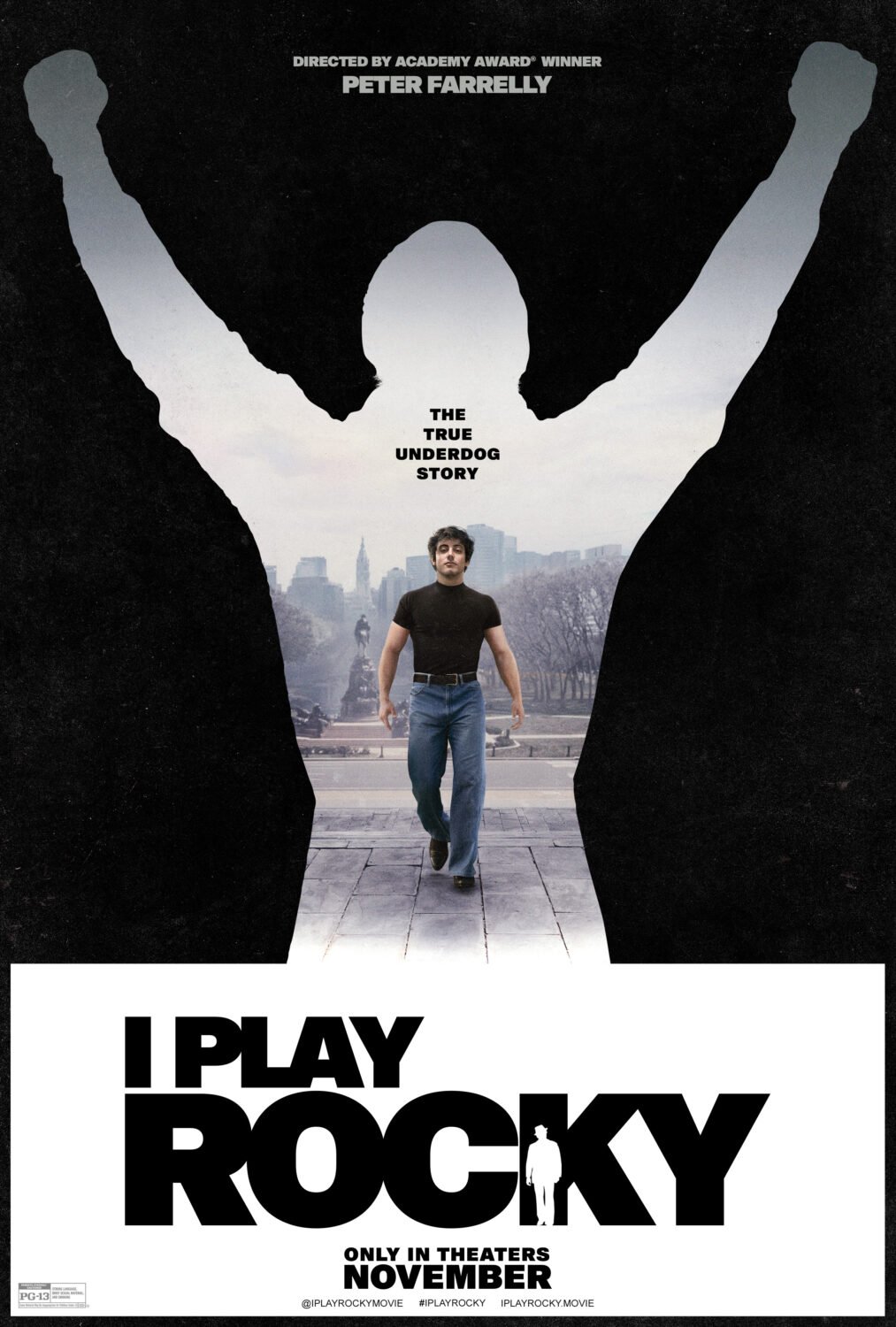
The film is an electrifying true story about an unknown actor with an unshakable belief that he wasn’t just meant to write Rocky—he was meant to be Rocky Balboa. Told “no” at every turn, Sylvester Stallone bets everything on himself, holding the line on playing the lead against seemingly impossible odds. The result is the ultimate underdog story behind the ultimate underdog movie.
Directed by: Peter Farrelly
Written by: Peter Gamble
Produced by: Christian Baha, Toby Emmerich, Paul Currie, Peter Farrelly
Cast: Anthony Ippolito, Matt Dillon, AnnaSophia Robb, P.J. Byrne, Toby Kebbell, Tracy Letts, Jay Duplass, Stephan James, Kiki Seto
I remember quite a bit about the 1976 release of Rocky. To think that only six months later, I would be introduced to Star Wars, another film that would leave a lasting impression on me. But Rocky was different. It left me with something that went beyond entertainment. It left me with hope, just like Star Wars did and didn’t. Every one of my friends, including myself, walked out of that movie thinking we could box. We quickly learned that two things existed in the real world: practice and Hollywood. Two very different things, believe me. Looking back, what we didn’t realize at the time was that Rocky wasn’t really a boxing movie at all. It was a love story that happened to have boxing in it. I didn’t fully appreciate that until many years after 1976. But director John G. Avildsen, portrayed wonderfully by Jay Duplass in I Play Rocky, reminded me of exactly what made that original film so special. It wasn’t about winning a fight. It was about finding a reason to fight in the first place.
I’ve been a Sylvester Stallone fan for years. I knew the struggles, the rejection, the financial difficulties, and the legendary story behind getting the original Rocky made. Or so I thought. I Play Rocky introduced me to details and key components of that journey I had never known, and those revelations made an already fascinating story even better. I found myself completely invested in every step. Every conversation, every negotiation, every argument over the contract, and every moment Stallone refused to surrender the one thing that mattered most to him: starring in the movie he had written. Here was a man with practically nothing, fighting against an industry that wanted what he created but didn’t necessarily want him. Think about that for a moment. Hollywood was willing to embrace his dream, provided he wasn’t the one living it. There’s something almost comical about that, but there’s also something incredibly sad. Director Peter Farrelly, working from a screenplay by Peter Gamble, captures that conflict beautifully. The story moves with purpose, never forgetting the emotional stakes behind every decision.
The entire cast in this film is absolutely brilliant. Every actor seems perfectly placed, and the chemistry between them is remarkable. A tremendous amount of credit belongs to casting director Rick Montgomery. This is one of those rare films where I didn’t find myself questioning a single casting decision. From the leads to the supporting players, everyone contributes something important. Even the smaller roles have a presence that makes the world around Stallone feel authentic. There are performances you admire, and then there are performances that make you forget you’re watching actors. I Play Rocky delivers plenty of the latter.
This film is about hope, much like its 1976 counterpart. Stallone was broke, at times homeless, struggling to find work, and desperately trying to turn acting into something more than an impossible dream. He believed he belonged in the business, but believing in yourself becomes increasingly difficult when everyone around you keeps saying no. That’s where his wife Sasha Czack, played beautifully by AnnaSophia Robb, becomes such an essential part of this story. Here’s where the movie completely changed my perspective on the relationship between the real Stallone and the characters he created. In many ways, the roles were reversed. Stallone, portrayed by Anthony Ippolito, was actually Adrian in real life, while Sasha carried much of the emotional strength we associate with Rocky. Stay with me here. Sasha was the one lifting Stallone when he was down, offering words of wisdom, challenging him to believe his dreams were within reach, and refusing to let him disappear into his own insecurities. She encouraged him to come out of that shell and become the man she already knew he could be. Adrian, in the original Rocky, was the quiet, meek individual who needed someone to recognize the strength within her. In I Play Rocky, Stallone himself possesses much of that same vulnerability. Yes, he has determination, but underneath that tough exterior is a man desperately searching for reassurance that he belongs. Sasha becomes his backbone, just as Adrian becomes Rocky’s emotional foundation. The similarities are striking, and once I recognized that connection, it completely changed the way I viewed the story. The fictional romance that inspired millions suddenly felt even more personal.
Anthony Ippolito, a relatively unknown actor given the enormous responsibility of portraying one of Hollywood’s most recognizable personalities, absolutely nails it. What an amazing performance. Playing Sylvester Stallone could have easily turned into an impersonation, complete with the familiar voice, mannerisms, and physical movements. Ippolito goes so much further than that. He captures the vulnerability, frustration, stubbornness, and unmistakable determination of a young man who has everything to prove and very little to lose. There are moments when you forget you’re watching someone portraying Stallone. You’re simply watching Stallone. That’s not an easy accomplishment, especially when the audience already knows the person being portrayed so intimately. Ippolito makes it look effortless, and his emotional range deserves serious recognition.
One particular scene involving Mickey, the character originally portrayed by Burgess Meredith and recreated here by Robert W. Morgan, absolutely floored me. The moment Mickey leaves Rocky’s apartment and Rocky unleashes his anger by pounding on the door is a showstopper. Anyone familiar with the original film knows exactly how powerful that sequence is. What I Play Rocky accomplishes is showing us the emotional work behind getting to that moment. Watching Sasha push Stallone to dig deeper, to find the anger and hurt necessary to make the scene believable, adds an entirely new dimension to something I thought I already understood. It met everything the original scene delivered, and in some respects, made me appreciate it even more. That’s brilliance. I honestly had no idea how deeply Sasha influenced Stallone during the creation of Rocky. Watching Stallone write the screenplay in roughly three days while Sasha types it all out, page after page, on a typewriter is simply awe-inspiring. It’s not just the creation of a screenplay we’re witnessing. It’s two people believing in something together, one providing the words and the other helping those words find their way into the world. There’s something incredibly romantic about that, and it ties directly back to why the original film worked so well.
The producers, Irwin Winkler, played by P.J. Byrne, and Robert Chartoff, played by Toby Kebbell, are another major highlight. Both actors are so perfectly in tune with their characters that I found myself eagerly anticipating their next appearance. Their exchanges with Stallone provide some of the film’s most entertaining moments, especially as the negotiations become increasingly complicated. You can almost see the frustration building as these businessmen attempt to understand why an unknown actor would refuse an opportunity most people would grab without a second thought. There are some genuinely funny moments within these negotiations, but the humor never overshadows what’s at stake. Actually, I’m lying about only anticipating their scenes. I did this with the entire cast. But these two were particularly fun to watch. The personalities, the timing, the frustration, and the constant back-and-forth are all handled beautifully.
Director John G. Avildsen, portrayed by Jay Duplass, becomes an immediate and impactful presence from the moment he enters the picture. Duplass absolutely kills it. What makes his portrayal so effective is the way he communicates Avildsen’s understanding of what Rocky needed to be. This wasn’t supposed to be another Hollywood boxing spectacle where the hero simply steps into the ring and destroys everyone in his path. It was about a man who wanted to prove he wasn’t a nobody. A man who wanted to go the distance, not necessarily win. Avildsen understood the humanity beneath the boxing gloves, and Duplass conveys that vision with conviction. He brings an understanding of the material that helps explain why the original film connected with audiences in such a profound way. The visual storytelling, the emotional simplicity, and the ordinary circumstances surrounding extraordinary determination all come together. Suddenly, the possibility of Rocky standing across the ring from a world champion isn’t what matters most. It’s the possibility of Rocky finally believing in himself. And that is something every single person watching can relate to.
There is also something to be said about the tremendous attention given to the filmmaking process itself. The original Rocky was not some enormous Hollywood production with an unlimited budget and endless opportunities to get everything right. The people involved had to make decisions, solve problems, and sometimes find creative solutions because the money simply wasn’t there. Those behind-the-scenes moments are fascinating. They add substance to the story without making the film feel like a documentary. Instead, we’re experiencing the pressures alongside the people responsible for putting everything together. Each hurdle becomes another obstacle to overcome, and the audience becomes increasingly invested in whether this seemingly impossible production will actually happen. The irony, of course, is that we already know the outcome. We know Rocky gets made. We know what it becomes. Yet I still found myself hanging on every decision as though the entire outcome remained uncertain. That’s how effectively this story is told.
As I mentioned earlier, the entire cast is brilliant, and I cannot gush enough about the performances or the nearly perfect placement and delivery of the dialogue. There’s an authenticity to the exchanges that pulls you into the moment. Nothing feels like it’s being said simply to move the story along. The words carry frustration, excitement, doubt, anger, and sometimes desperation. The effort to tell the story of Stallone’s uphill battle to finally get his shot is completely enthralling. And then there’s the money. Oh, the money. Turning down $360,000 in 1976 would be roughly the equivalent of turning down $2.1 million in 2026. There’s a question worth asking yourself. What if you had a project, an invention, a screenplay, or something you were so passionate about that you refused to part with it for $2.1 million unless you remained a major part of it? What if someone offered you that amount of money right now to walk away from your dream? Granted, $2.1 million in today’s financial climate isn’t necessarily going to set you up for life, depending on your circumstances, but come on, it’s still $2.1 million. Now add a baby on the way. You’re behind on your rent or mortgage. Bills are piling up. Your career isn’t going anywhere, and your next paycheck is about as predictable as the weather. That changes the conversation a little, doesn’t it? Most people would sign that contract so quickly the ink wouldn’t have time to dry. But there are those very few individuals who possess an almost irrational belief in what they’ve created. Stallone was one of them. He wasn’t simply negotiating for more money. He was fighting for ownership of his own opportunity, the chance to prove that he was the right person to bring his character to life. There’s a tremendous difference between selling a dream and actually living one. I Play Rocky makes you understand that difference.
Then there’s the scene with Stallone and Sasha in the rain, involving the Volkswagen. What an incredible emotional moment. For me, this was the scene that completely solidified their relationship and gave the audience the emotional connection it needed. Everything about it works. The setting, the dialogue, the performances, and the vulnerability shared between these two people come together beautifully. I became completely tied to these characters from that moment forward, and I never wavered afterward. I wasn’t simply observing their struggles anymore. I felt like I was a part of them. I wanted things to work out for them, not because I knew how the story ended, but because the actors had convinced me that these were two people worth caring about. That’s one of the hardest things any film can accomplish. You can have beautiful cinematography, an incredible script, and all the production money in the world, but if the audience doesn’t care about the characters, none of it means much. Farrelly and his cast master that essential ingredient. Every supporting actor contributes to that emotional investment, while Ippolito and Robb are simply more icing on an already wonderful-tasting cake.
What makes I Play Rocky especially remarkable is that it isn’t simply relying on nostalgia to get the audience through the story. Yes, the familiar moments are there. Yes, the references to the original movie will bring a smile to anyone who grew up loving Rocky. But the real substance comes from discovering the people, relationships, sacrifices, and circumstances behind those moments. I’ve watched the original film more times than I can count, and I thought I understood what made it special. This movie reminded me that knowing a film by heart doesn’t necessarily mean knowing the hearts of the people who made it. There’s a difference. The relationships behind the camera, particularly Stallone’s connection with Sasha, add an emotional layer I never expected. It’s a story of perseverance, faith, courage, love, and the refusal to allow someone else to determine your worth. There are moments of humor, moments of frustration, and moments that genuinely pull at your heart. More importantly, there’s a sense of sincerity throughout the film that never left me. I believed in these characters, even though I knew they were portraying real people whose stories had already been written.
And perhaps that’s what impressed me most. I Play Rocky takes a story with an ending everyone already knows and somehow makes the journey feel new again. We know Sylvester Stallone becomes a superstar. We know Rocky becomes one of the most beloved films in cinematic history. We know the Academy Awards, the sequels, and the cultural phenomenon that follows. But when you’re watching this movie, all of those accomplishments become secondary. You’re reminded of a struggling young man who could barely get anyone to take him seriously, who had a woman beside him who saw something special, and who refused to abandon the one opportunity that could change everything. Before the fame, before the fortune, before the legendary character became a household name, there was simply a dream. And a whole lot of people telling him it wasn’t going to happen.
I Play Rocky is a masterpiece, much like its 1976 counterpart. I, for one, absolutely loved it. Not because it recreated moments from a movie I grew up with, but because it made those moments mean even more to me. I left this film with a greater appreciation for Sylvester Stallone, for Sasha Czack, for John G. Avildsen, and for everyone who helped turn an unlikely idea into cinematic history. Fifty years later, the same feeling I experienced watching Rocky came rushing back. Hope. That simple, powerful belief that no matter how impossible something appears, there’s still a chance if you’re willing to fight for it. If you think you know the full story behind the making of Rocky, you don’t. I certainly didn’t. If you loved the 1976 film as much as I did, you’re going to adore this. And even if you’ve never seen the original, there’s a tremendous story here about believing in yourself when the rest of the world doesn’t. Anthony Ippolito delivers an extraordinary performance, AnnaSophia Robb gives the film its emotional heartbeat, and Peter Farrelly brings it all together with a level of sincerity that completely won me over. This is filmmaking that reminds us why we fall in love with movies in the first place. Go see this film. Full stop.
-Jay Katz