The Social Reckoning – Movie Review
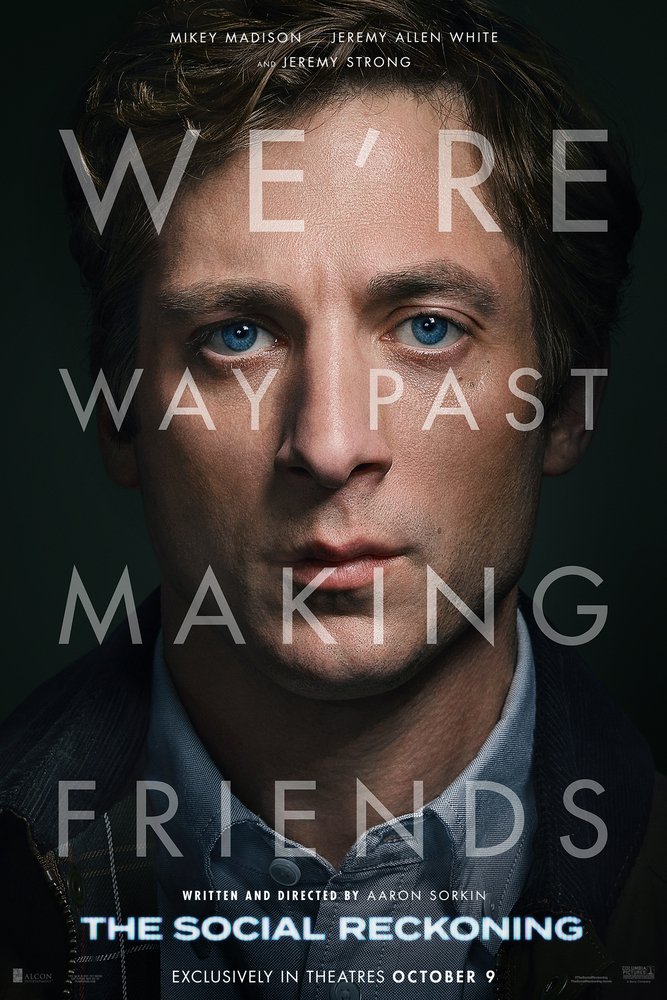 The Social Reckoning – Movie Review
Follows Frances Haugen, a young Facebook engineer, who enlisted the help of Jeff Horwitz, a Wall Street Journal reporter, to blow the whistle on the social network’s most guarded secrets
Aaron Sorkin
Aaron Sorkin
Stars
Mikey Madison
Betty Gilpin
Jeremy Allen White
Bill Burr
The Social Reckoning is pretty much exactly what one would expect if you had your ear to the ground and followed The Wall Street Journal’s Facebook Files investigation when it unfolded in 2021. But just because you may already know the story doesn’t make the movie any less dramatic.
The film does a solid job of piecing together the long road of getting the story straight, verifying the facts, and ultimately putting one of the biggest social media companies in the world under a microscope. At the heart of it all is a pretty uncomfortable question: Do social media companies have a moral responsibility to tone down false narratives, misinformation, lies, and negativity when those things can have a real impact on society? And if they do, where does that responsibility begin and end? When does a company have an obligation to police its own platform? Is doing so censorship? Is misinformation protected under the umbrella of free speech? And what happens when outrage and misinformation are also profitable?
There are a million different directions you could take that debate, and people are going to land on very different sides of it. But this is a movie review, not my personal soapbox, so I’m going to try to dance around those opinions and stick mostly to reviewing the film. Try being the key word.
The movie itself does a good job explaining what Facebook’s algorithms were designed to accomplish and, more importantly, the damage the film argues those algorithms were inflicting on the American psyche. At the center of the story is Facebook whistleblower Frances Haugen, played by Mikey Madison. Haugen was the former Facebook employee who provided thousands of internal company documents that became the foundation for the investigation. Madison is good in the role, although I thought she leaned a little too heavily into Haugen’s meekness and eccentricities early on. At first, it felt overplayed and, honestly, a little annoying. As the movie progressed, though, the performance started to grow on me. Once I settled into what Madison was doing with the character, it worked much better.
Then there’s Wall Street Journal reporter Jeff Horwitz, played by Jeremy Allen White. Horwitz is the investigative reporter who worked with Haugen and whose reporting helped bring the internal Facebook documents into public view. White is a great fit for the role because there is something naturally trustworthy about him as an actor. He has a way of playing sensitive, caring characters without making them feel weak. Here, he never feels like a reporter trying to bully someone into giving him a story. Instead, there’s patience to his performance. He understands the fragile mental and emotional position Haugen is in and gives her the space to get there on her own. That patience is important because the stakes of what he’s uncovering are enormous. The movie essentially has him trying to pull apart what it presents as one of the biggest social-media manipulation stories in modern American history.
And then there’s Zuckerberg. Mark Zuckerberg is played brilliantly by Jeremy Strong, who takes over the role previously played by Jesse Eisenberg in The Social Network. Strong absolutely disappears into Zuckerberg. Everything from the speech patterns to the mannerisms felt so spot-on that there were moments when I almost forgot I was watching an actor. At one point, I genuinely caught myself feeling like Zuckerberg himself was in the movie. That’s probably the film’s strongest performance.
Interestingly, The Social Reckoning does make an attempt to humanize Zuckerberg toward the end of the film. Whether that works will probably depend heavily on how you already view the man. For me, by that point, it was too little, too late. One decision doesn’t erase everything that came before it, nor does it magically turn Zuckerberg into the hero of this particular story.
Bill Burr plays Charlie Garrigan as the one voice of reason willing to push back against Mark Zuckerberg. There are moments when you can clearly see Burr’s own personality coming through—the blunt delivery, the impatience, that familiar sense that he’s two seconds away from telling someone exactly where they can go. But those qualities work for the character. He brings conviction to his dialogue, making Garrigan’s frustration feel earned rather than performed for the sake of a dramatic moment. Burr understands how to put weight behind a line without making every exchange sound like a speech, and that helps his scenes feel believable. His passion comes through in both the sharper confrontations and the moments when he simply needs to make a point and let it land. Yes, we’re getting plenty of “Bill Burr,” but there’s enough purpose behind the performance to keep that familiarity from becoming a distraction. He gives Garrigan a backbone and makes him someone you want to hear from, especially when everyone else could use a little more of his common sense.
Overall, the film has points it wants to make, and it makes them. The problem is that sometimes it takes a little too long getting there. If you already know the Facebook Files story, you’ll probably find yourself wishing the pacing were tighter. There are moments when the movie feels like it’s circling around something you’re already waiting for it to say. Eventually it gets there, and when it does, the point lands, but the journey occasionally drags.
That doesn’t mean the movie isn’t effective. It definitely has its moments. I just wouldn’t call much of it shocking, particularly if you’ve been following Facebook, Zuckerberg, and the controversies surrounding the company for years. Some of the statistics and events presented in the film, however, are genuinely thought-provoking. They reinforce just how enormous Facebook’s influence over information became and raise a troubling question: if millions of people are relying on an algorithm to determine what information reaches them, what responsibility does the company controlling that algorithm have for the information it amplifies?
That’s ultimately where The Social Reckoning is at its best. It makes you ask questions.
If you’re in the mood for an afternoon or evening at the movies followed by a debate with your partner, friends, or family, this one will absolutely give you material. Where does freedom of speech end and corporate responsibility begin? Does a company have a moral obligation to combat misinformation when spreading that misinformation is profitable? And does freedom of speech also mean a private platform has an obligation to amplify information it knows may be false or harmful?
Those are complicated questions, although I suspect plenty of people walking out of this movie will believe the answers are obvious. Which side you fall on will probably say something about how you look at freedom, responsibility, corporate power, and morality.
Then again, I have a platform too. So maybe I have an obligation to exercise my freedom of speech. If a billionaire can do it, so can I.
-Jay Katz